Discover the real results of your advertising campaigns
You focus on online conversions, such as form submissions, but do you also know which leads will actually become customers?
With offline conversion tracking, you can link offline conversions such as sales, qualified leads, or paying customers back to your advertising platforms.
Offline conversion tracking is the measurement and reporting of results that do not occur directly online, but were initiated through your advertisements. Examples include a lead that later becomes a customer, a quote that is accepted, or a subscription that is taken out after contact with sales.
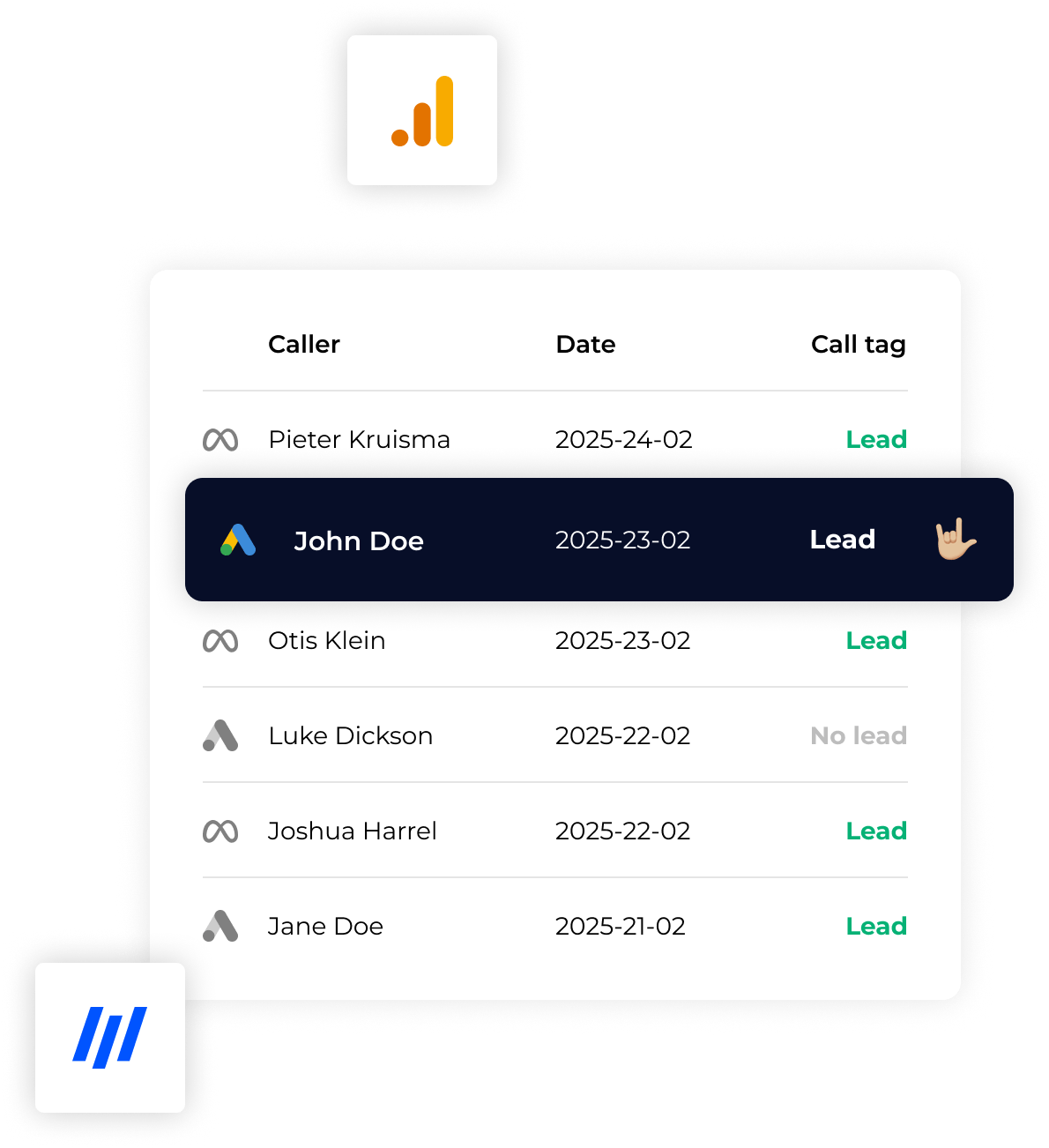
Normally, advertising platforms only see the first action, such as a form submission. Everything that happens after that, in your CRM or sales process, remains invisible. As a result, algorithms optimize based on volume, not real value.
Better performing campaigns
Lower costs per customer
Which offline conversions can you measure?
With offline conversion tracking, you decide which results are important to track. This varies depending on your business model and sales process. The most common offline conversions are:
Sales of paying customers
Qualified leads (e.g., SQLs or MQLs)
Closed deals or contracts
Subscriptions or upgrades
subscription_started
converted_lead
subscription_started
Offline conversion tracking for Google Ads and more
We link offline conversions not only to Google Ads, but also to platforms such as Google Ads, Meta, LinkedIn, and TikTok.
This allows you to see not only where most leads come from, but also which channels generate the most customers. It may be that Meta generates a lot of leads, while Google has less volume but generates more customers.
Integrating offline conversion data
Offline conversion tracking works well when it aligns with how your team operates. We connect your advertising platforms to your existing systems, such as CRMs, ATSs, marketing tools, and proprietary software.
We have integrations ready for commonly used platforms. For platforms for which we do not yet have a standard integration, we create customized solutions. Your team's working methods do not need to change.
YesWeTrack helped us set up server side tracking and offline conversion tracking. This gives us more insight into which campaigns are important to us. YesWeTrack makes switching easy; they are really our lifeline for everything regarding tracking. Highly recommended!
5.0
Sophie van Gorsel
Marketing Manager - Makelaarsland
Collecting offline conversion data
To set up offline conversion tracking effectively, we map out your customer journey. This starts on your website and continues in your systems, such as your CRM, proprietary software (SaaS), or ATS (recruitment). This allows us to record what happens after the online conversion and which actions generate value.
Customized connections with your systems
No standard solution, but tailored to your process
We speak the language of your developer
Sending data back to advertising platforms
Once the data has been retrieved from your systems, we send it back to your advertising platforms, such as Google Ads, Meta, LinkedIn, and TikTok. We set up the links in such a way that the algorithm learns from your customers, turnover, or accepted deals. This improves the performance of your campaigns and allows you to focus on quality and return on investment.
Better performance per advertising platform
Beat your competition in ad auctions
Stronger position in advertising auctions
Campaigns that learn smarter and perform better structurally
How does offline conversion tracking work ?
Offline conversion tracking shows what happens after the online conversion. Not just the form or the click, but the steps that follow: a lead becoming a customer, a trial converting to a paid subscription, or a job applicant actually being hired.
In the video below, we show how this works in practice.
Results of offline conversion tracking with YesWeTrack
All-in Tracking
Offline Conversion Tracking (OCT)
Server Side Tagging
How Informer uses campaign budgets more intelligently by targeting customers
How Makelaarsland now focuses on real purchases and sales
Makelaarsland wanted to get a grip on the actual yield of their advertisements. Thanks to an All-In Tracking implementation, the marketing team now focuses on concrete sales and purchases of homes.
We come from the world of online marketing agencies ourselves. There, we saw how campaigns were optimized based on forms and clicks, not on sales, customers, or revenue.
That's why we set up offline conversion tracking the way we would want it as marketers ourselves: letting advertising platforms learn from what really matters, namely revenue, qualified leads, and closed deals. With custom connections that link to your CRM and other systems.
Built by marketers
Customized connections with CRMs, software, and ATS systems
Full implementation
Win in your industry with offline conversion tracking
Frequently Asked Questions About Offline Conversion Tracking
Offline conversion tracking is particularly suitable for companies with a sales process that follows the lead. Examples include B2B, SaaS, recruitment, high-ticket services, and subscriptions, where conversions do not take place directly online.
Offline conversion tracking is set up by linking your website, CRM, or other systems to your advertising platforms. We ensure that relevant data (such as sales or qualified leads) is automatically sent back.
Offline conversions show which online leads ultimately deliver real results, such as customers, revenue, or contracts. This data is used by advertising algorithms to optimize campaigns more intelligently based on quality rather than just volume.
Offline conversion tracking is particularly valuable when the conversion process is not completed directly online. Examples include lead generation, B2B sales, SaaS, recruitment, or situations in which sales take place later via CRM, email, or telephone.
Offline conversions are linked via unique identifiers, such as click IDs or first-party data. This allows advertising platforms to know exactly which click, campaign, or target group led to a customer or sale.
Find out which campaigns actually bring in customers