Call tracking Google Ads
Many companies invest in Google Ads and focus on clicks and form submissions. That makes sense—it’s what you see, and it’s measurable.
But what if a large portion of your leads actually come in over the phone? Then you're missing out on something. And not just a little bit, either.
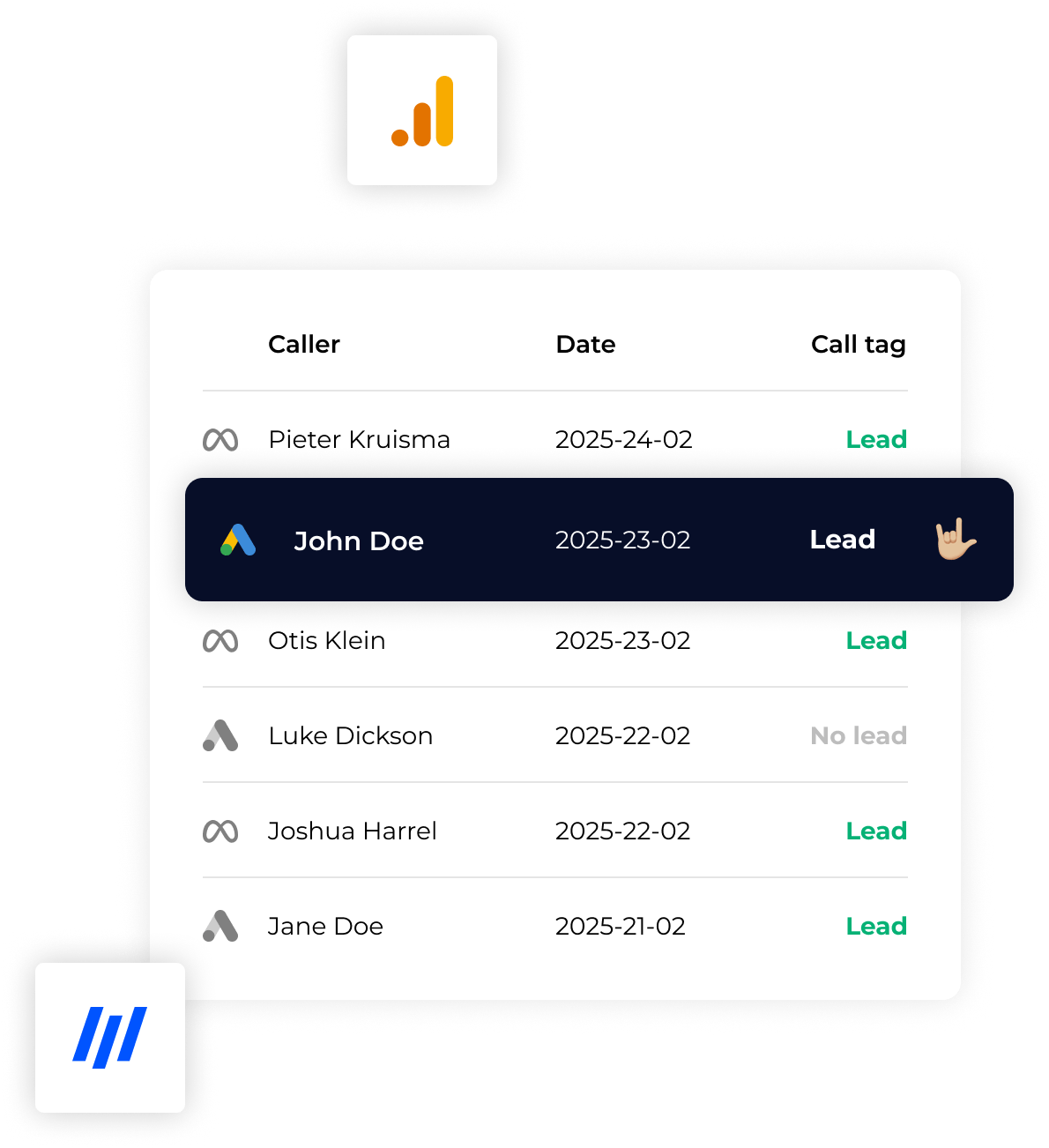
With call tracking Google Ads, you can instantly see which campaigns, keywords, and ads are generating phone calls. And perhaps even more importantly: which calls actually lead to results.

Why call tracking Is call tracking for Google Ads
By default, Google Ads actually only captures a limited part of the picture.
What you do see:
- Click
- Conversions on your website
- Sometimes phone extensions
But in practice, something else happens. Or rather, something extra.
Many visitors simply call right after visiting your website. This is especially true in industries where speed is of the essence, or where someone just wants to discuss something briefly.
| Without call tracking | With call tracking |
|---|---|
| Not sure where the calls are coming from? | Links phone calls to campaigns |
| Are you running your campaigns based on incomplete data? | See which keywords actually generate leads |
| Are you missing out on valuable conversions? | Focuses on quality, not just volume |
How does call tracking work call tracking Google Ads?
The principle is actually quite simple. But its impact… is usually greater than people expect.
Step 1: A visitor clicks on your ad
Someone clicks on your Google Ads ad and is taken to your website.
Step 2: Dynamic phone number
The visitor sees a unique phone number on your website. That number is linked to the click that just took place.
Step 3: The call is connected
When a visitor calls, that call is linked to the original click.
- Including the campaign
- Advertisement
- And even the keyword
Step 4: Send data back to Google Ads
The call is tracked as a conversion in Google Ads.
And that's when things start to get interesting. Because the algorithm is now learning which campaigns actually generate phone calls.
What can you measure with call tracking?
With the right setup, you suddenly see much more than just the number of calls. And that’s usually when people realize: Okay, we should have done this sooner.
- Which campaigns generate phone calls
- Which keywords generate calls
- Which conversations lead to sales?
- What determines the quality of a call
And that last point is perhaps the most important of all. Because not every conversation is automatically valuable. This is precisely the difference between focusing on volume… and focusing on value.
Why phone calls are often more valuable than leads
Not every conversion is the same. You probably know that deep down, but many accounts still treat them as if they were. In many industries, the following generally applies:
- A form = lower intention
- A phone call = greater intent
Someone calling:
- often has a question right away
- wants to act more quickly
- is closer to making a purchase
That doesn't mean forms are worthless—far from it. But calls often go a step further.
Common mistakes in call tracking
Measure clicks only
You're missing out on all the phone conversions. And there are often more of them than you think.
No connection to Google Ads
Calls are not returned, which means the algorithm doesn't learn from them either.
Measure volume only
More calls do not automatically mean better performance.
No insight into keywords
You don't know what really makes for meaningful conversations.
With a good call tracking , you can prevent this kind of thing. Or at least—for the most part, anyway.
Call tracking Google Ads = better performance
When you send phone calls back to Google Ads, something interesting happens.
- The algorithm learns faster
- Bidding strategies are getting smarter
- Your cost per acquisition is decreasing
- Your ROI will increase
And that’s because you’re finally focusing on what really matters: meaningful conversations.
Bonus: optimizing call quality
With modern solutions, you can take it a step further. And this is often where the real difference is made. Consider:
- Evaluate calls
- Assigning values to calls
- Distinguish between meaningful conversations and less relevant ones
This means you’re no longer focusing on “the number of calls,” but on quality. And while that might seem like a minor detail, it really isn’t.
Why call tracking makes call tracking difference
If phone calls are a key part of your sales process, then call tracking isn’t call tracking a luxury. Without this insight, you’re making decisions based on incomplete data. You see part of the picture, but not the whole story.
With call tracking , you call tracking on real results—on the calls that matter.
Want to know which campaigns, keywords, and ads are driving valuable phone calls? Then find out how to set upcall tracking Google Ads. This is essential for maximizing your Google Ads performance.